
Audio Branding Congress 2010 report

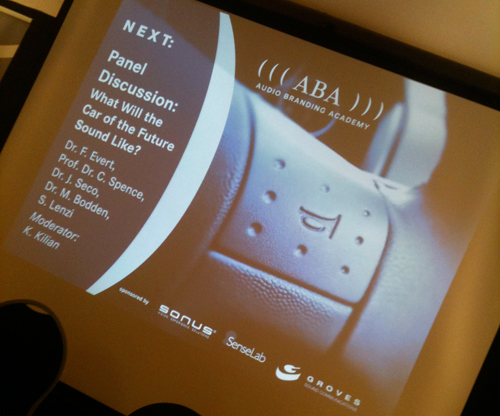
Panel discussion: What will the car of the future sound like?

Panel discussion: What will the car of the future sound like?

The second edition of the Audio Branding Congress was held in Hamburg at the conference rooms of the Dialog im Dunkeln, an amazing exhibition located in the old warehouse district called Speicherstadt. As for the last year the congress was organized by the Audio Branding Academy, an indipendent institution founded in 2009 by Cornelius Ringe, Kai Bronner and Rainer Hirt, with the aim to promote the connection between sound and brand communication.

The title of this edition was Driven by Sound and the main topics were two: the relationship between multisensory design & brand experience and the sound of the electric cars in the future.

I and Sara were invited to present Sound for Electric Vehicles, the work we are conducting in Lorelei for the FIAMM Group, the italian company leader in the market of horns and acoustic devices.
Continue reading

Electric dust for cars: working with FIAMM to create the future of sounds for electric and hybrid vehicles

It will be one of the most critical issues for the automotive industry in the next three years: the sound of electric cars (EV) and hybrids (HEV). If you own a car, a motorcycle or a spaceship, it’s impossible that you never heard about the friendly Nissan LEAF, the sexy Fisker Karma or the worldwide well-known Toyota Prius. These will be the cars of our future, a new industrial mashup made of design, innovation and green technology.

This is surely nice, but electric and hybrid vehicles have a huge problem: they’re quiet. Too quiet. A conventional combustion-engine vehicle when stationery emits a sound of 50 dB, while the noise generated by an electric one is 0 dB. At a speed of 12 km/hr the conventional car is at 60 dB, the electric car is at 50 dB. When moving at a speed bigger than 20 km/hr, the intensity of the emitted sound is the same for all the vehicles, due to the friction with the ground. The reduced sound signature of hybrid and electric cars introduce a safety concern to cyclists and pedestrians, because they hardly detect vehicles at low speeds. This problem becomes more dramatic for blind and visually impaired pedestrians, who use auditory informations, like noise generated by vehicles, to localize streets, crossroads and make decisions in order to move safely.

I and Sara are working in Lorelei with FIAMM, world leader in the market of acoustic devices, for the development of a solution to the problem of quiet electric cars. Our mission: to guarantee the safety on the roads, but not only…

Continue reading